Table of Contents
- Why Media Placement Still Wins for Emerging Beauty Brands in 2026
- Strategy 1: Build a Beauty Brand Media Kit Editors Actually Open
- Strategy 2: Learn How to Pitch Beauty Editors Without Wasting Their Time
- Strategy 3: Run a Beauty Product Seeding Strategy That Earns Real Coverage
- Strategy 4: Study Beauty Press Coverage Examples Before You Send Anything
- Strategy 5: Measure Media Placement Results Beyond the Clipping
- Mistakes That Sink Emerging Brand Media Outreach
- Conclusion: Choosing the Right Placement Approach for Your Brand
- Frequently Asked Questions
Last Updated: October 6, 2026
Why Media Placement Still Wins for Emerging Beauty Brands in 2026
Paid ads get more expensive every year. That is why media placement remains the most reliable way for a young beauty brand to buy attention it does not have to keep renting.
Media placement is the work of getting your brand into trusted publications and platforms through editorial coverage rather than paid advertising. It builds brand trust faster than any ad set can.
At SRK Collective, we combine over 30 years of industry expertise to help beauty and lifestyle brands land coverage that lasts.
The stakes keep rising. Consumers now scroll past obvious ads and lean on editorial recommendations instead.
Strategy 1: Build a Beauty Brand Media Kit Editors Actually Open
A beauty brand media kit is a short, visual document that gives editors everything they need to write about you in one place. Most emerging brands either skip it or bury the good parts.
Here is what belongs in the kit:
- Brand one-liner (what you make and who it is for)
- Founder story in three sentences, not three paragraphs
- Product line with hero images and retail prices
What to cut: long mission statements, generic stock photos, and anything an editor has to hunt for. Editors work on tight deadlines.
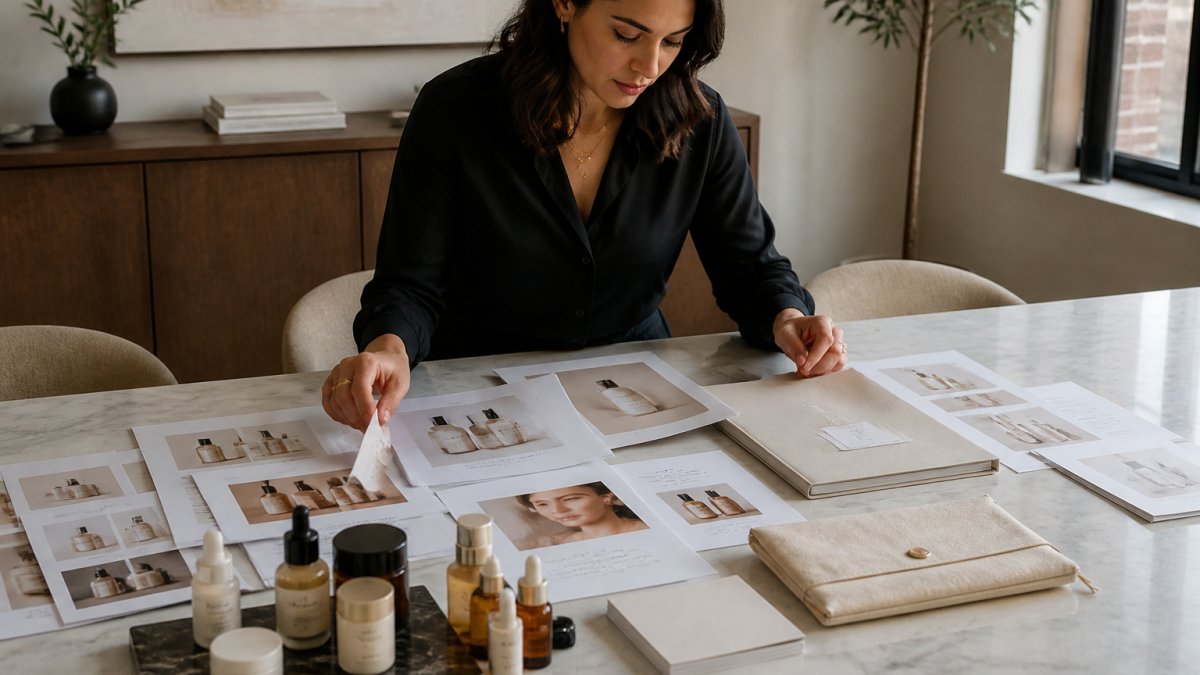
Name your media kit file “BrandName_MediaKit_2026” and keep it under 10MB. Editors download dozens of kits a week, and a clean file name gets yours opened first.
Strategy 2: Learn How to Pitch Beauty Editors Without Wasting Their Time
Learning how to pitch beauty editors comes down to one rule: make their job easier. A pitch is not a press release. It is a short, specific offer tied to something the editor is already covering.
Most pitches fail for three reasons:
- They lead with the brand, not the story
- They are too long
- They arrive with no timing logic
Match the Pitch to the Channel
Not every outlet works the same way. Before you write a single email, sort your target list by channel, because lead time and fit change everything.
| Channel | Typical Lead Time | Best Fit For | What Editors Need |
|---|---|---|---|
| Beauty editors (print + digital) | 6-12 weeks for features; 2-4 weeks for digital | Trend pieces, ingredient stories, founder profiles | A named angle, high-res images, expert access |
| Trade publications | 4-8 weeks | Retail launches, funding, formulation news | Business context, numbers, a quotable founder |
| Podcasts | 3-6 weeks | Founder story, category POV | A host-friendly narrative and a clear segment idea |
| Newsletters | 1-3 weeks | Product discovery, niche ingredient education | A short blurb, a link, and a sample if relevant |
| Broadcast (local + national) | 2-6 weeks | Visual demos, seasonal hooks | A producer-ready segment with a visual payoff |
| Digital creators | 1-4 weeks | Tutorials, first-person reviews | Product in hand, a brief, and creative latitude |
A common pattern is that emerging brands over-index on digital creators because the lead time is short, then wonder why branded search never moves. Editors and trade press take longer but tend to produce coverage that keeps working after launch week.
Subject Lines, Timing, and Follow-Up Rules
Your subject line should name the angle, not the product. “New serum launch” gets deleted. “The ingredient dermatologists keep flagging for barrier repair” gets opened.
Timing matters. Pitch seasonal stories six to eight weeks ahead. Pitch trend pieces when the trend is peaking, not after. And follow up once, three to five days later. A second follow-up rarely helps.
Two mechanics separate brands that land coverage from brands that do not:
- Embargoes. If you are offering a story to one outlet first, say so in writing and name the lift date. An embargo is a promise, not a suggestion, break it once and that editor stops replying.
- Exclusives. An exclusive is a stronger version of an embargo: one outlet gets the story first, everyone else gets it after. Use exclusives sparingly, and only when the outlet’s audience actually matches yours.
Build the Relationship Before You Need It
Editors cover people they know. That relationship starts long before your launch.
- Follow the editors who cover your category and reply to their work with substance, not flattery
- Offer yourself as a source on stories you are not pitching, a quote on a trend, a data point from your customers
- Keep a simple tracker: name, outlet, beat, last contact, next reason to reach out
Blasting the same pitch to 50 editors at once is the fastest way to get blacklisted. Beauty editors talk to each other, and a mass pitch reads as spam.
Put your pitch in the body of the email, not in an attachment. Attachments get stripped by spam filters and add a step the editor has to take before they can say yes.
Strategy 3: Run a Beauty Product Seeding Strategy That Earns Real Coverage
A beauty product seeding strategy means sending products to a short, targeted list of editors and creators before you ask for anything. The goal is familiarity, not a guarantee.
The mistake most brands make is seeding wide and hoping. Send 200 packages and you get a handful of mentions, most of them low value.
A better approach:
- Build a list of 15-25 editors and creators who already cover your category
- Personalize each package with a handwritten note and one clear angle
- Include a one-page fact sheet, not a full press kit
- Follow up once after delivery, with no ask attached
- Track who opens, posts, or replies
Seeding works because it lets an editor experience the product before a pitch lands. According to FTC guidance on endorsements and reviews, any gifted product that leads to coverage must be disclosed, so make disclosure easy for the recipient.
Strategy 4: Study Beauty Press Coverage Examples Before You Send Anything
Studying beauty press coverage examples before you pitch teaches you what editors actually publish. Pull five recent features from your target outlets and break each one down.
How to Break Down a Winning Placement
For every piece of coverage you admire, note:
- The angle the editor chose
- The hook in the headline
- Whether a founder, expert, or product was featured
This exercise does two things. It shows you the patterns editors repeat, and it gives you pitch angles that already have a proven home. When you pitch, reference the pattern directly: “You covered X last month; here is the same trend from a new angle.”
Strategy 5: Measure Media Placement Results Beyond the Clipping
A clipping is not a result. Measuring media placement properly means tracking what the coverage actually did for your business, and most emerging brands stop at the screenshot. The gap in nearly every guide on this topic is the same: nobody tells you how to attribute the coverage or what a realistic outcome looks like.
Set Up Attribution Before the Coverage Drops
You cannot measure a placement you did not prepare for. Before you send a single pitch, do three things:
- Tag your links. Use UTM parameters on every link you give an editor so referral traffic lands in its own bucket in your analytics.
- Create a branded-search baseline. Note your current branded search volume in Search Console so you can see the lift after coverage runs.
- Set up a simple coverage log. One row per placement: outlet, date, journalist, angle, link, and notes on message pull-through.
Without these three, you are guessing. With them, you can tell the difference between a placement that drove traffic and one that just looked good on a press page.
The Metrics That Actually Matter
| Metric | What It Shows | Where to Find It | Realistic Read |
|---|---|---|---|
| Referral traffic | Readers who clicked through | Analytics (UTM-tagged) | Often a small spike in week one, then a long tail |
| Branded search lift | Awareness that outlasts the click | Search Console | The most durable signal of earned media value |
| Share of voice | Mentions vs. competitors | Media monitoring tools | Useful for trend tracking, not for ROI |
| Backlinks and domain authority | SEO value of the placement | Backlink tools | High-authority links compound for months |
| Message pull-through | Whether key claims were repeated | Coverage audit | Tells you if your positioning is landing |
| Conversion rate | Sales from referred visitors | Ecommerce dashboard | Compare against your paid-channel baseline |
The placement that matters most is the one that keeps working after launch week. A single feature in a trusted outlet can drive branded search for months. A dozen low-tier mentions often fade in days.
How to Read the Numbers Without Fooling Yourself
A few patterns show up again and again:
- Referral traffic is usually smaller than founders expect. A strong placement might send a few hundred to a few thousand visitors in week one. The value is in the branded-search tail, not the click spike.
- Branded search is the better long-term signal. If people are searching your brand name after reading about you, the coverage did its job even if they did not click.
- Share of voice is a trend metric, not a scorecard. Use it to see whether your category presence is growing quarter over quarter, not to justify a single pitch.
Build a Simple Monthly Review
Once a month, pull your coverage log and answer four questions:
- Which placements drove the most branded-search lift?
- Which outlets sent the most qualified referral traffic?
- Which pitches produced coverage that repeated our key message?
- Which outlets have never converted, and should come off the list?
That review is what turns media placement from a cost center into a compounding channel. It also tells you where to spend your next round of pitching effort, which is the whole point.
Judge coverage by what it does after the news cycle ends, not by how many logos you can stack on a press page.
Mistakes That Sink Emerging Brand Media Outreach
The same four mistakes show up again and again in emerging brand outreach.
- Pitching without a media kit. Editors cannot write about what they cannot verify.
- Seeding too broadly. Wide, shallow seeding produces weak mentions.
- No follow-up plan. One pitch, no reminder, no coverage.
Fix these four and your outreach gets sharper immediately. Most brands also underestimate how much brand positioning drives results. Editors cover brands with a clear point of view, not brands that try to be everything.
Conclusion: Choosing the Right Placement Approach for Your Brand
Media placement rewards precision over volume. The brands that win coverage in 2026 are the ones with a tight story, a clean media kit, and a short list of editors who actually care.
If you want that work handled by a team that lives in this space, SRK Collective is built for it. We focus on intentional visibility rather than volume, act as a seamless extension of your team, and specialize in celebrity brands, hospitality, and professional services.
Frequently Asked Questions
How do emerging beauty brands get media coverage without a big PR budget?
Start with earned media rather than paid placements. Build a tight media list of 15 to 20 editors who already cover your category, personalize each pitch around a specific angle, and send product samples only after an editor expresses interest. A focused media placement push with a clear hook often outperforms a mass email blast. Trade publications, regional lifestyle outlets, and niche beauty newsletters are realistic first targets before national glossies.
What should a beauty brand media kit include to get editor attention?
Keep it to one page plus assets. Include your brand story in two sentences, founder background, product line with retail prices, high-resolution images, ingredient or formulation highlights, and current availability. Add any existing press mentions and a direct contact. Editors skip kits that read like sales decks. A beauty brand media kit works best when it answers three questions fast: what is it, why now, and who is it for.
Are product samples useful for earning beauty press coverage?
Yes, when they follow interest rather than replace it. A beauty product seeding strategy works best after an editor replies or when you know they cover your exact category. Send full-size or generously sized samples with a short note tying the product to a story angle, not a generic press release. Unsolicited mass seeding wastes budget and often goes unopened, since editors receive dozens of packages weekly.
How do you measure whether a media placement actually worked?
Track more than the clip. Measure referral traffic from the outlet, branded search lift in the weeks after publication, social mentions, and whether the placement led to follow-up coverage or partnerships. Ask new customers how they found you during the placement window. A single top-tier feature can drive authority for months, while ten low-relevance mentions may produce nothing measurable.